Solana news: Why Solana's Price Lags Despite ETF Inflows and Network Growth
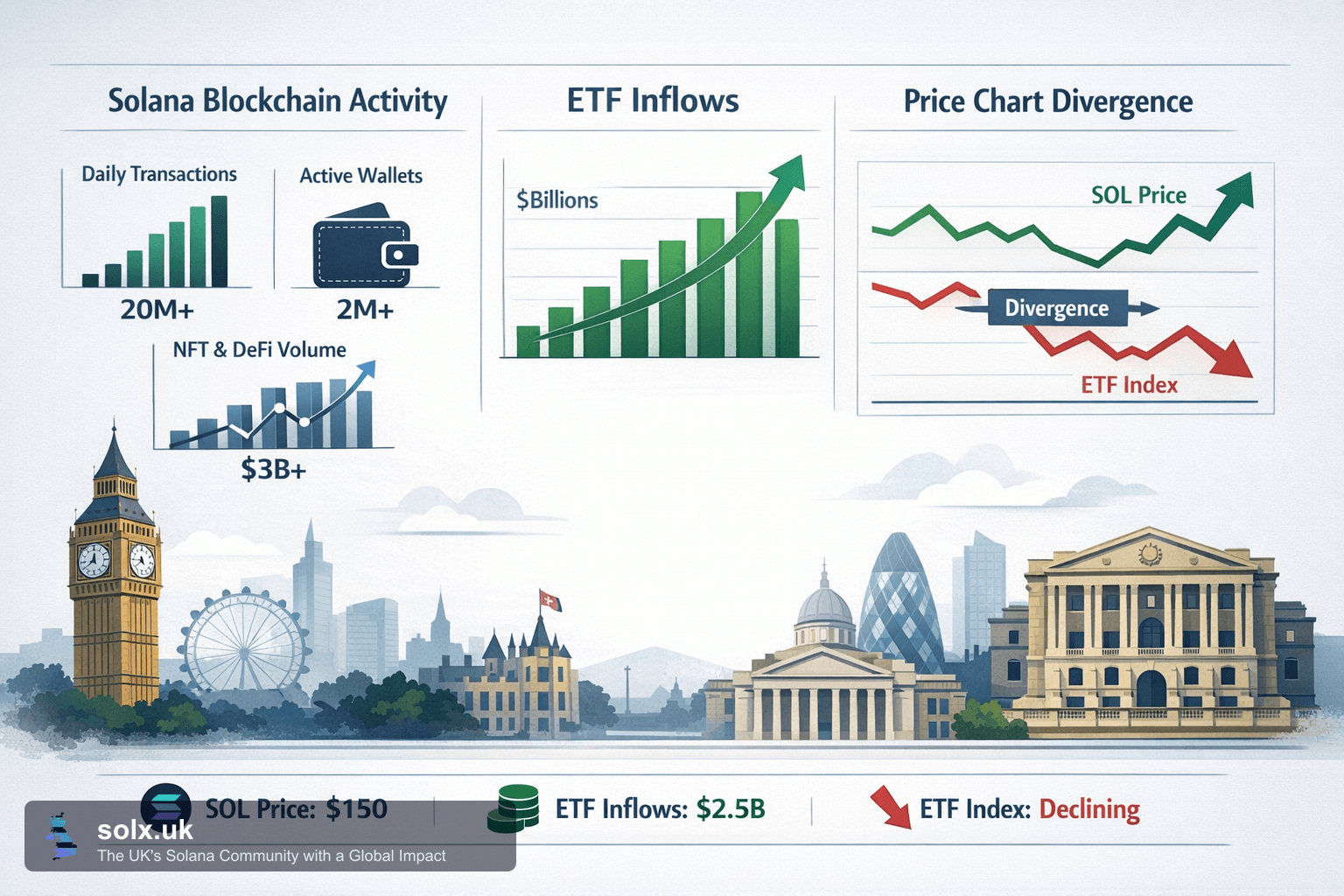
Solana Activity Surges, Price Stagnates
Solana has seen significant growth in network activity and institutional interest. Spot ETF assets under management (AUM) surpassed $1 billion by the end of May, with $115.3 million in net inflows, marking the strongest month of 2026. Tokenised real-world asset (RWA) market cap reached $2.8 billion, stablecoin supply exceeded $16.4 billion, and perpetuals trading volume hit $64.6 billion. Solana also accounted for 97% of cumulative on-chain tokenised-equity spot trading volume.
Disconnect Between Usage and SOL Price
Despite these metrics, SOL trades near $63, down from previous highs. Analysts attribute this to Solana's current fee and value-capture structure. Network activity benefits validators, issuers, and platforms before reaching SOL holders. The fee system splits base fees 50/50 between burning and block producers, while priority fees—dominant during high activity—go entirely to validators. As a result, increased usage does not directly translate to higher SOL value.
Tokenomics and Value Capture
Solana's inflation rate starts at 8%, with a 15% annual disinflation rate, aiming for a 1.5% long-term floor. At the current pace, terminal inflation is reached in about 5.7 years. Without significant burn or staking demand, ongoing issuance dilutes SOL holders. The current burn rate is around 648 SOL per day, modest compared to network throughput.
Proposed Reforms: SIMD-0550 and SIMD-0547
- SIMD-0550: Proposes doubling the annual disinflation rate to 30%, shortening the path to terminal inflation to 2.8 years and reducing future SOL emissions by an estimated $1.5 billion.
- SIMD-0547: Suggests introducing a resource-based base fee that is fully burned, so burn scales with network usage.
Both proposals are under active community debate, with support from core contributors. Their adoption could strengthen the link between network activity and SOL value, addressing current market concerns.
Macro Factors and Market Sentiment
Broader market dynamics also impact SOL. Large IPOs, such as SpaceX, can draw liquidity away from crypto, affecting high-beta assets like Solana. The UK market, with its growing interest in digital assets and institutional products, is watching these developments closely for regulatory and investment implications.
Why This Matters for the UK
For UK investors, builders, and regulators, Solana's evolving tokenomics and institutional adoption highlight the importance of understanding how blockchain activity translates to asset value. Ongoing reforms may influence future investment strategies and regulatory approaches in the UK market.