
Solana news: Latency Wars on Solana: The Edge of Faster RPC and Earlier Block Data
Understanding Latency in Solana
Solana’s ecosystem is experiencing a shift where network latency is becoming a key differentiator. While token performance and user experience remain important, the focus is moving to milliseconds of advantage in RPC (Remote Procedure Call) latency and block data visibility.
Why RPC Latency Matters
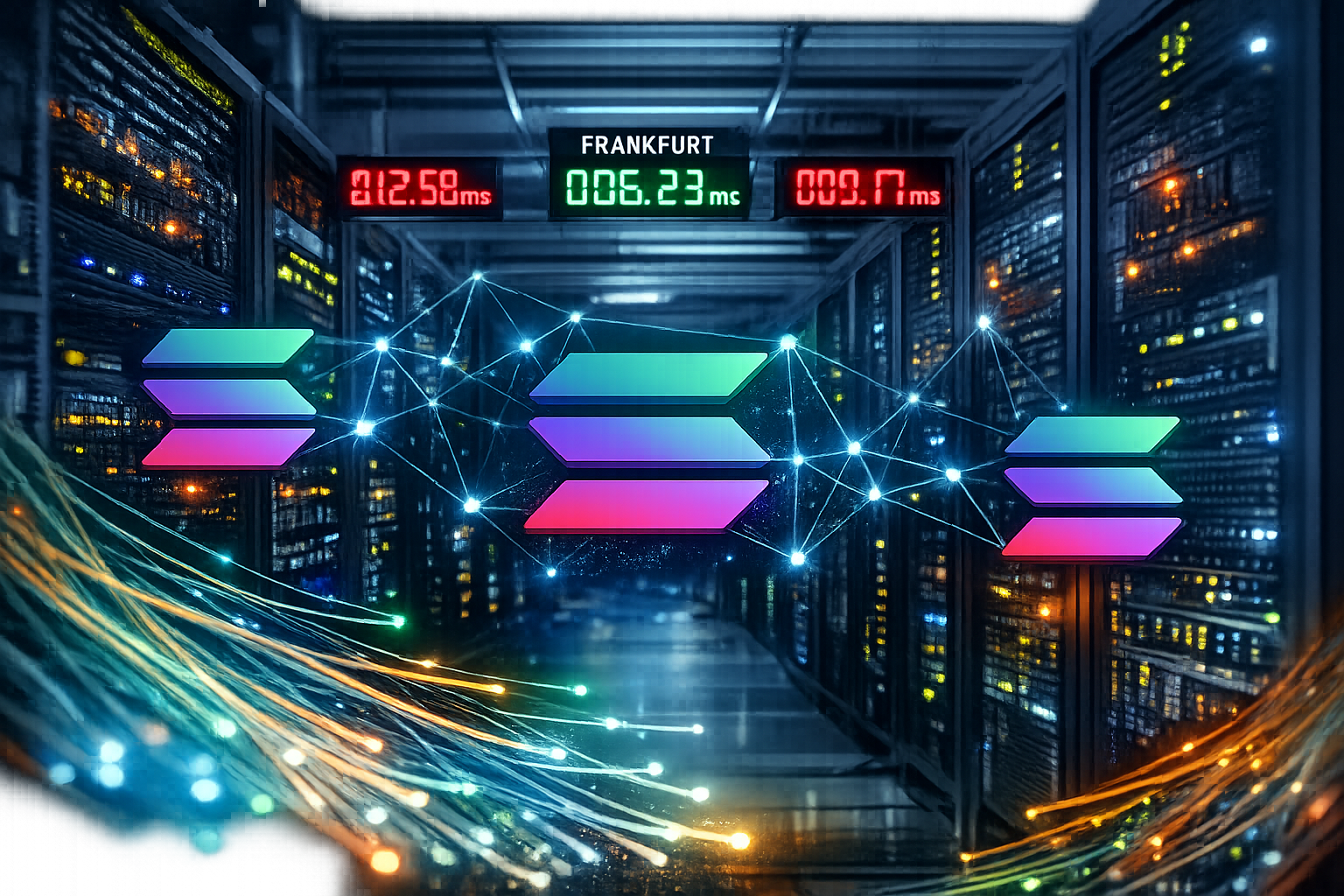
Recent benchmarks highlight significant improvements in RPC latency. For example, GetBlock reports ~6ms latency in Frankfurt, outperforming other European locations and achieving up to 2× faster speeds than standard Solana RPC in real-world tests. Lower latency directly impacts:
- Order placement timing
- Arbitrage opportunities
- Liquidation races
- MEV (Maximal Extractable Value) capture
A slow RPC layer can delay transactions before they even reach the network, affecting downstream performance for traders and automated strategies.
Earlier Block Data: A New Advantage
Beyond RPC speed, earlier access to block data is emerging as a structural advantage. GetBlock’s StreamFirst claims 140–150ms earlier block visibility compared to standard Yellowstone gRPC, achieved through optimized validator positioning and shred propagation. This allows users to react to network events sooner, not just send transactions faster.
Who Benefits Most?
While casual users may not notice these improvements, quant teams, high-frequency traders, and MEV searchers rely on every millisecond. A 100–150ms edge can determine who captures arbitrage opportunities or secures a place in the next block.
Europe as a Latency Battleground
Frankfurt, Amsterdam, and London are emerging as key network hubs due to their connectivity and proximity to financial infrastructure. These regions are becoming focal points for latency-sensitive activity as Solana adoption grows among both retail and institutional users.
Outlook: Infrastructure as Strategy
The competition on Solana is moving beyond protocol speed to who can access data and execute transactions first. As infrastructure providers optimize for lower latency and earlier block visibility, milliseconds are becoming a decisive factor in trading and strategy.